What Are the 7 Baby Step to Personal Financing What Are the 7 Baby Step to Personal Financial
Dave Ramsey is a personal finance expert and is near well known for his seven baby steps to assist you exit of debt and take command of your money. While these steps have helped millions of people, they are not perfect. Below I'll walk through the pros and cons of Dave Ramsey's Baby Steps and provide some alternative options along the way.
Earlier diving in, I want to put on the record that I concur with most of what Dave Ramsey has to say when it comes to personal finance, and I remember he'south helped a ton of people throughout his career. I even included his book, The Total Money Makeover, in my listing of the all-time budgeting books.
Getting out of debt, investing for retirement, and having a handle on your finances are all keen things, and all are things that Ramsey recommends.
Who is Dave Ramsey?
Equally mentioned, Dave Ramsey is a personal finance guru and the founder of Ramsey Solutions – the company behind his website (daveramsey.com) and personal finance empire.
This empire now includes:
- The Dave Ramsey Show – Dave's pop radio prove where listeners typically call in with their money bug and questions
- The Full Coin Makeover – His all-time selling book
- Ramsey+ – The ultimate membership bundle of Ramsey products and services, including Financial Peace Academy, EveryDollar, and more
- EveryDollar – A budgeting app
- The Website – Which hosts everything above and much more than
Dave didn't build this empire overnight, though. And the master reason he got into the business of personal finance was considering of mistakes he made.
Ramsey struggled with debt when he was young and eventually overcame it. He then decided he wanted to assistance others avoid paying the "stupid tax" (mistakes that price you money) as he did. Those are his words, not mine!
Today, Dave is arguably almost well known for his 7 baby steps to help people go out of debt, seen below.
Dave Ramsey's vii Infant Steps:
- Infant Step ane: Save $1,000 in an emergency fund
- Baby Step two: Pay off all debt (except your mortgage) using the debt snowball method
- Baby Step 3: Save 3-vi months of expenses in an emergency fund
- Baby Step 4: Invest 15% of your household income for retirement
- Infant Step 5: Salve for your children's college fund
- Babe Step 6: Pay off your domicile early
- Baby Step 7: Build wealth and requite
These steps serve every bit a blueprint for anyone trying to go on rail with their finances. Beneath, nosotros'll break down the details of each pace and the pros and cons of this process overall.
Breaking Down the Dave Ramsey 7 Baby Steps
Baby Step 1: Relieve $one,000 in an Emergency Fund
The first step in Ramsey's plan is to salve $1,000 in a "starter" emergency fund.
An emergency fund consists of coin you set aside to encompass unexpected expenses that might pop upwards. These expenses could include things like a surprise medical bill or necessary house repair. An emergency fund is typically stored in a liquid account, similar a loftier yield savings account, then that y'all take immediate access to information technology when needed.
Emergency Fund Definition: Money stored in a liquid business relationship (like a savings account) to encompass unexpected expenses.
This first baby step serves two primary purposes.
For ane, if a small repair or accident comes upwards, you can handle it without going into debt. That'south a win.
Second, it gets the ball rolling on your financial journey. Ane g dollars is a lot of coin, but not an insurmountable corporeality. Ideally, you tin reach this outset footstep in less than a year (by saving $20/week), if not much faster.
At present, will a $ane,000 emergency fund pay for a new roof that needs to be replaced? Or cover you for a few months if you lose a job?
No, and I don't call back that's the point of this "starter" fund. I've heard Dave say on his bear witness that only having $1,000 is supposed to scare yous a little. Information technology's a modest win, and it protects you against minor expenses, but it doesn't make yous experience comfortable. That comes in step three.
One terminal thing to note earlier moving on – the backbone of the entire baby footstep procedure is to have a sound budget. If you are spending more than you are making, you won't save any money, let alone $20 a calendar month. Part of this showtime step needs to exist devising a upkeep and identifying ways to either increment income or subtract expenses as you move through the baby steps.
Pro Tip: Ane way to commencement saving money is to lower the electric current bills you lot already pay. Trim is a personal finance app that can assistance you practice only that, and more.
Merely Start Investing Thoughts:
Generally speaking, I like this get-go infant step and retrieve it's a neat place to first for most people.
I like that the initial emergency fund is minor on purpose to let someone to get a quick win, but too because there are better ways to use your coin outside of only putting it in a savings account. For example, paying off debt or getting your total employer match in a 401(yard).
Baby Step ii: Pay Off All Debt (Except Your Mortgage) Using the Debt Snowball Method
In footstep 2, the recommendation is to pay off all of your debt (except for your house), including credit card debt, student loan debt, motorcar loans, and personal loan debt, using the debt snowball method.
With the debt snowball method, you pay off your smallest debts first, ignoring each loan's interest rate (while always making minimum payments on each loan). For case, allow's say you had three forms of debt:
- Credit Carte Debt: $10,000 with a 20% interest rate
- Automobile Loan: $5,000 with a 3% interest charge per unit
- Student Loan: $25,000 with a 7% interest charge per unit
Using the debt snowball payoff method, you would first completely pay off your car loan. Then, you would tackle the high-involvement credit carte, and last would be the student loan.
Similar to step one, you lot employ your budget to accomplish this goal. Saving more and earning more until you take paid off all of your debt.
The main idea backside the debt snowball method is that the psychological benefit of completely eliminating a loan or type of debt outweighs the money saved by paying off high-interest debt beginning. A study by Northwestern in 2012 substantiated this theory.
In the example higher up, going from 3 types of debt to only two types is, in theory, more important than going from $twoscore,000 in debt to $35,000 in debt.
Just Start Investing Thoughts:
It'south difficult to contend with the phycology behind this arroyo. It might work for most people, but my mathematical brain would make me take a dissimilar approach on two fronts.
For one, I would employ the debt avalanche method of paying down debt, which involves tackling your debt with the highest interest rate commencement. In the example above, that would hateful starting with the high-interest credit carte debt, and then moving on to the student loan debt, and finishing with the car loan.
In the end, as long as y'all pay the aforementioned amount of money towards the debt, this arroyo will save you coin in the long run by lowering the full amount of interest paid.
2d, I don't think that every form of debt outside of your mortgage is "bad debt." I can meet an argument for not aggressively paying downward whatever debt with an interest rate of 5% or beneath. That is because every additional debt payment has an opportunity price, and yous could invest your coin instead. If you can capture a seven% render, you lot would exist meliorate off investing!
That said, information technology'south difficult to fence with becoming debt-free. So while I agree with eliminating debt in principle, I don't call up it's your only selection.
Baby Step 3: Save 3-half dozen Months of Expenses in an Emergency Fund
The 3rd infant step involves revisiting stride 1.
Now that you have all of your debt paid off (as well your house), it'south time to build up a more comfy, fully funded emergency fund. One that could comprehend more than considerable unexpected expenses that pop upward and prevent you from always needing to go into debt over again.
Of course, in that location are exceptions. You might decide to become back to schoolhouse, or maybe you oasis't purchased your business firm notwithstanding, just the thought of baby pace 3 is to terminate you lot from needing to take on "bad debt" (i.e., maxing out credit cards) to solve a short-term problem.
Open up a High Yield Savings Account: Ane of best places to store an emergency fund is in a loftier yield savings account. Cit Bank is ane choice that offers competitive involvement rates and is worth checking out!
But Start Investing Thoughts:
Over again, while this is not necessarily bad advice, it is non communication that I would follow.
First, I would get my 401(k) employer match if offered to me. This is free coin that should exist taken advantage of sooner than later on.
Second, I don't think there is a one-size-fits-all recommendation with emergency funds, as outlined in this article. For a young, single person with a relatively stable chore, having a one-month emergency fund might exist enough. Notwithstanding, a family of five living on one income that has a mortgage might feel more comfortable with a twelvemonth saved up.
Aiming to save three to six months is fine and a expert dominion of thumb, simply it is not the requirement before you can start investing, which brings united states to pace four.
Baby Stride 4: Invest 15% of Your Household Income for Retirement
Step four is a big one – it involves saving and investing for retirement.
Specifically, Dave recommends investing 15% of your gross household income in a 401(k) and Roth IRA (or other pre-tax retirement accounts). He besides recommends investing in mutual funds (specifically, growth mutual funds) equally the investment vehicle of choice.
A general rule of pollex is that y'all need 25x your annual expenses saved up to comfortably retire (read more on the 4% rule here). If you lot relieve xv% of your gross annual income as Dave recommends (and spend the other 85%), it will accept you about 35 years to save enough for retirement.
This is holding a few basic assumptions abiding:
- Your spending level does not change in retirement
- Your income level does not modify
- You realize a +7% annual render
It's important to run the numbers to understand if waiting 35 years is adequate or if you plan to retire sooner or after. You can and then arrange your assumptions and savings rate from in that location to meet your goals.
Merely Start Investing Thoughts:
My outset annotate builds on that concluding point – 15% is a rule of pollex. It will not fit the needs of anybody.
For some people, savings fifteen% might be impossible, and saving 10% (and waiting closer to twoscore years to retire) will have to do.
For others, perchance those that are chasing financial independence and early retirement (Burn down), their goal might be to salve threescore% of their income so that they can retire in under twenty years.
Either mode, you lot need to effigy out your retirement goals and prioritize them earlier moving on to step 5.
I'll also add that I agree that both 401(k)southward and Roth IRAs are neat places to salve for retirement. Health Savings Accounts are another astounding business relationship if available to you lot.
The ane attribute of Step 4 that I volition build on is that depression-cost index funds might be a better choice than traditional mutual funds, which typically come with a higher fee that can add together up over time. Edification, Charles Schwab, and Vanguard are all places where you will discover low-price funds to invest in (at that place are many other skilful online brokers, those are only 3 great ones).
Hither is some more than reading on index funds and investing costs if you lot are interested:
- How to Choose the All-time Alphabetize Funds
- What are Expense Ratios?
Baby Footstep 5: Relieve for Your Children's College Fund
Once you have paid off all of your debt (again, except the house), built upwards a stable emergency fund, and started actively saving for retirement, Dave recommends saving for your children'south futurity education.
Specifically, it'due south recommended that you lot open a 529 Higher Savings Programme or Education Savings Business relationship (ESA). These are both taxation-advantaged accounts, similar to a 401(k) or Roth IRA, but explicitly designed to exist used for education expenses.
Just Start Investing Thoughts:
If you have kids and are financially stable (which you would be if you made it through steps 1-iv), saving for their future education is a smashing gift to requite them.
Withal, I retrieve in that location are some "risks" to consider regarding saving for your kids' college teaching.
Your kid might go a scholarship or make up one's mind college isn't for them. And while with most tax-advantaged college savings accounts, you lot tin can change the casher to someone else (or pass it onto their kids), it does add a wrinkle to things.
So I think this is a skilful pace, but not a mandatory one.
Baby Pace six: Pay Off Your Home Early on
Footstep 6 is probably the well-nigh controversial on the list.
Dave recommends paying off your mortgage early and getting to 100% debt-free, no matter the interest rate on your loan.
It'southward hard to argue with… "100% debt-free" has a nice ring to it, doesn't it?
Of course, yous have to make sure you can make additional payments against your mortgage principal without facing penalties. And if you can, you should, co-ordinate to the vii infant steps.
Only Start Investing Thoughts:
Heed, as I said, information technology'south hard to argue with eliminating all your debt. Just look at the state of consumer debt in the US – Americans currently owe $xiv.3 trillion! That means the average household carries over $100,000 worth of debt (assuming 122 million households).
Plus, this is the chief purpose of the baby steps – helping you lot get out of debt!
And so, aye, in full general, I agree that debt is bad and should be eliminated when it makes sense to exercise so mathematically. However, with a mortgage, it normally does not make sense to do then mathematically.
With an average existent return of +seven%, technically, your coin would be better off in the stock market (assuming your mortgage interest rate is below 7%, and most are beneath 5%) over a long menstruation of time.
This assumes a few things, though:
- Y'all are far from retirement – otherwise, the guarantee of a 3-4% return (the mortgage interest) is likely better than a gamble in the stock market place for a brusk catamenia of time.
- Y'all will actually invest the difference – not paying downwardly your mortgage and ownership a new pair of jeans instead of investing the money does not leave you lot financially better off.
- You have the stomach for it – some folks might want the guaranteed render that comes with paying downwards a mortgage, and that's fine; it'southward all the same a solid render on your money!
Baby Step 7: Build Wealth and Give
Terminal, step seven is a celebratory step. It's the stride where I imagine Dave finally says, "congrats, yous did it."
With your debt paid off, retirement on rail, child's higher paid for, and no mortgage, you are free to exercise with your coin every bit you please. Some common suggestions include:
- Max out your 401(k) and Roth IRA, ensuring a total and happy retirement
- Go on edifice wealth in a brokerage account
- Invest in real estate
- Requite money to charities that mean something to y'all
- Spend money on things you enjoy without guilt
Just Start Investing Thoughts:
This footstep is the vaguest, merely I more often than not concur with information technology. At this point, I call up maxing out retirement accounts and investing in low-cost index funds and ETFs in a brokerage account are both great options.
I would besides phone call out here that using a credit card would be a wise thing to practise. Yous could do it earlier on equally well; the fundamental to using a credit carte is to spend inside your upkeep and not spend just because it'south easy.
Peculiarly in step 7, when you allow yourself to spend on things y'all enjoy, using a credit menu to rack up rewards points is another added perk.
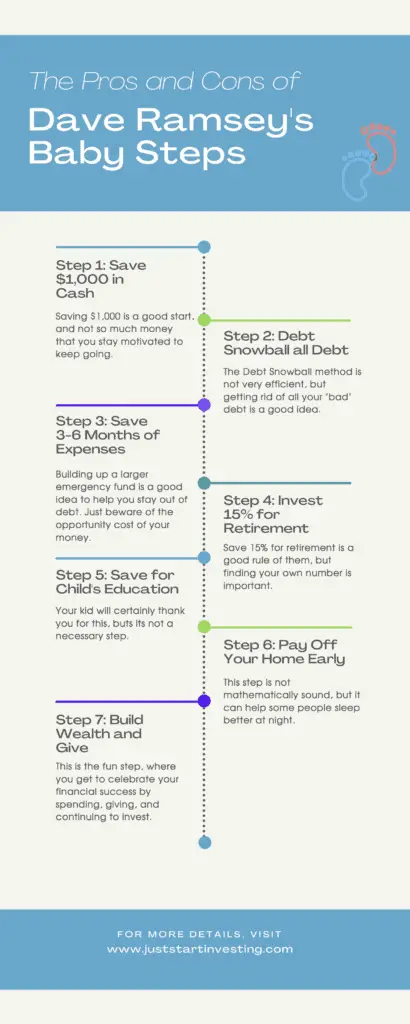
Pros and Cons of Dave Ramsey'southward Baby Steps Plan
Dave Ramsey Infant Steps Pros:
Ownership: Dave Ramsey puts the ownership on yous to take control of your finances, rather than finding exterior factors to blame (which could be right or wrong). The baby steps emphasize that the most productive thing to exercise is take buying and accept action.
Bias for Activity: Like the pro to a higher place, the infant steps encourage you lot to human activity now, not afterwards. There is no reason to start adjacent month or next yr; everyone can first working through the baby steps today.
Keeps Yous Focused: The steps are simple and designed to exist tackled ane at a time, making it easier for you to succeed and gives you a reason to celebrate along the journey!
It Works: there are plenty of success stories out there, from Brittany to Bob and Tammy.
Dave Ramsey Babe Steps Cons:
Non E'er Financially Sound: As you lot saw in the "Only Showtime Investing Thoughts" in every section in a higher place, the babe steps lean on behavior over math. I wrangle with this balance ofttimes, and even more than so since reading misbehaving by Richard Thaler. The rational side of me wants to recommend the mathematically audio action, while the empathic side of me realizes that people can be motivated in different ways.
Ane-Size-Fits-All: The baby steps are a one-size-fits-all framework, and I think they should be more fluid. Whether you are pursuing FIRE or want to open a credit bill of fare, some exceptions should be considered. I realize that a framework such as this ane starts to get fuzzy the more exceptions you lot grant, and so this is more than of a call-out on how to use the baby steps rather than a con of the infant steps.
Items Left Out: The infant steps are supposed to exist simple, but some essential items were left out of the framework, including getting insurance, saving for a business firm, and tracking your finances. They are implied throughout the process but non explicitly stated with their ain step.
Summary: Dave Ramsey Baby Steps
Overall, I am a fan of the Dave Ramsey babe steps and think it'southward a solid framework for paying off debt and taking control of your finances.
All the same, I think information technology is a framework that should be modified to fit your needs, within reason.
Tin you save a smaller emergency fund before you lot commencement to invest? Sure.
Can you forego paying off your mortgage and invest instead? Absolutely.
Should yous put every dollar you take into Bitcoin and Tesla stock options? Probably non.
The baby steps should bend but not break. Overall, I remember the 7 baby steps is a good (not perfect) framework that volition work for most people trying to accept the first pace to improve their financial situation and achieve fiscal freedom.
Source: https://www.juststartinvesting.com/dave-ramsey-baby-steps/

Post a Comment for "What Are the 7 Baby Step to Personal Financing What Are the 7 Baby Step to Personal Financial"